Framing Pain as Necessary.
Labels: abortion, catholic church, david mills, end of life care, first things, hospice, redemptive suffering, wesley j smith
Labels: " assisted suicide, abortion, culture war, pain and suffering, redemptive suffering
The so-called murder-suicide of a North Haven couple suffering from Alzheimer’s and cancer touches me, not only sympathetically, but personally. I have a longtime friend who, as I write, is facing a prolonged dying in "the American way."
She is a virtual prisoner of what, echoing President Dwight D. Eisenhower, one might call "the medical-religious complex."
Certainly, there are reasons to hold life sacred and to beware the institutionalization of death-dealing. Counterweighing these is the respect due to an individual’s autonomy in matters of ultimate value, especially the quality of one’s own life and death.
My friend has led an active, meaningful life, but now finds herself unable even to read, or to take pleasure in personal company, or to get out of her hospice bed, because of both the pain of her illness and the grogginess induced by the drugs used to combat her pain. While everyone caring for her is well-intentioned, the fact is, as she just put it to me, "I want this to be over yesterday."
Arguments against euthanasia are complex and far more difficult to make, she said.
"Today, the argument for euthanasia is the easiest to make," she said, noting the concern for the autonomous individual. "It's my right, my body. The individual has the right to choose death."
The arguments against euthanasia concern its effects on institutions, such as the health care system, hospitals, doctors and society as a whole, she said.
People often argue that we are merciful to dogs by euthanizing them, so why shouldn't we do the same for human beings, she said. "We're not dogs!"
Somerville said one of the biggest challenges is to argue there is something special about human beings without using religious reasons.
Traditional religion used to serve as a way of putting talk of death into a context of eternity, she said. "It is very difficult to justify suffering without some form of religious argument."
Labels: " euthanasia, aid in dying, assisted suicide, redemptive suffering, religion
I was also pleasantly surprised to find that an Islamic Code of Medical Ethics had been produced in 1981 in the First International Conference on Islamic Medicine held in Kuwait, and in it euthanasia was addressed quite squarely. Among the relevant pronouncements, however, one finds: “The claim of killing for painful hopeless illness is also refuted, for there is no human pain that cannot be largely conquered by medication or by suitable neurosurgery...”; “A physician should not take an active part in terminating the life of a patient, even if it is at his or her guardian’s request, and even if the reason is severe deformity; a hopeless, incurable disease; or severe, unbearable pain that cannot be alleviated by the usual pain killers. The physician should urge his patient to endure and remind him of the reward of those who tolerate their suffering.”
Finally, in an interesting recent article published in an Iranian journal of medicine, Aramesh and Shadi (2007) present the orthodox views of Islamic scholars (Shiite and Sunni), but at the very end try to show some “flexibility” by pointing to two instances where “passive assistance in allowing a terminally ill patient to die” would be permissible under Islamic law: (a) “administering analgesic agents that might shorten the patient’s life, with the purpose of relieving the physical pain or mental distress”; (b) “withdrawing futile treatment on the basis of informed consent (of the immediate family members who act on the professional advice of the physicians in charge of the case), allowing death to take its natural course.”
Labels: assisted suicide, euthanasia, islam, redemptive suffering, you don't know jack
Wasn’t Anderson Cooper just swimming with sharks last week on “60 Minutes”?
Now he’s doing something even more courageous: he’s interviewing Dr. Jack Kevorkian.
Dr. Death is giving Cooper his first post-prison interview this Friday. It’s not actually on CNN, but set for a lunch time live get together at CNN headquarters in New York.
The interview will be preceded by sandwiches and snacks, according to the invite, and a welcome from CNN’s prez, Jon Klein.
You have to give Cooper credit for doing this. His own brother, Carter, committed suicide at age 23 in July 1988. Anderson wrote about it in his blog back in 2005: http://www.cnn.com/2005/US/08/16/brother/
Talk about a charged meeting. Kevorkian has said he helped at least 130 people die of physician assisted suicide. He served 8 years of a 10 to 25 year prison sentence for second degree murder. He’ll turn 81 in May.
Labels: " assisted suicide, aid in dying, futile care, redemptive suffering, suicide
Canada will discuss C-384, a bill to legalize assisted suicide there, in May. In today's Hamilton Spectator, Paul Kokolksi writes against the bill, citing the same arguments that we hear here in the US. My least favorite argument is that which endorses end of life suffering - in line with the theological concept of redemptive suffering espoused by the Catholic church, that the more pain we feel, the closer we are to God.
For all of the talk about a "slippery slope" with our "culture of death," I find there too is a slippery slope to the acceptance of suffering. We have the ability to relieve suffering for the dying but suffering brings us closer to God. We have the ability to relieve poverty, inequality, racism, hunger, abuse, injustice...but suffering brings us closer to God? If the concept of redemptive suffering prevents us from relieving suffering for the sake of converting those in pain, we have reduced our moral imperative as humans to a mission for the church. I can't think of a less humane premise than this.
Here's a clip:
Our present culture tends to consider suffering the epitome of evil. In such a culture there is a great temptation to resolve the problem of suffering by eliminating it at the root, by hastening death so that it occurs at the moment considered most suitable. True compassion leads to sharing another's pain; it does not kill the person whose suffering we cannot bear.
The pleas of the gravely ill who sometimes request death should not be understood as implying a true desire for euthanasia; in fact, it is almost always a case of an anguished plea for help and love. Intentionally causing one's own death, or suicide, is a rejection of God's sovereignty and loving plan. It is a refusal of love for self, the denial of a natural instinct to live, a flight from the duties of justice and charity owed to one's neighbour and to society.
No one should be allowed to permit in any way the killing of an innocent human being, whether a fetus or an embryo, an infant or an adult, an old person, or one suffering from an incurable disease, or a person who is dying. The moment a positive law deprives a category of human beings of the protection which civil legislation ought to accord them, the state is denying the equality of all before the law.
In the Netherlands, a policy originally encompassing only persistent requests for death from hopelessly suffering and dying patients has steadily expanded so that physicians have been allowed to kill patients who were physically healthy and handicapped children who never asked for death.
The Netherlands stands as a stark reminder of the slippery slope leading from supposedly limited killing to a broader culture of death.
There exists in contemporary culture a certain Promethean attitude which leads people to think that they can control life and death by taking the decisions about them into their own hands. What really happens in this case is that the individual is overcome and crushed by a death deprived of any prospect of meaning or hope. What any sick person needs, besides medical care, is love -- the human and supernatural warmth provided by those close to him such as family, nurses and doctors.
Labels: " assisted suicide, Canada, end of life care, ERDs, pvs, redemptive suffering, removal from artificial nutrition and hydration
Changing the law would enshrine the idea that we can and should choose the time and place and manner of our death. Death would come under our control. Inevitably, we would use that new power in such a way as to avoid the pain and suffering which dying often entails; and we would soon be persuaded that it was a generous thing to do, because it would free up NHS budgets.
And this new cultural norm would gradually dispense with the whole object of dying, which is precisely that it is out of our control. Those who accompany the dying – as I did recently, at the bedside of my father – know that it is an incredibly profound process, the crystallisation of human life and meaning.
snip
A good death is only one kind of death: it's when God – or Nature, if you don't believe – remains in charge of the moment, and a person surrenders to that invitation, hopefully borne lovingly by family and carers, after a gruelling journey of renunciation. That's why killing – whether in war, murder, suicide, or assisted death – can never result in a good death. God doesn't kill.
And that's why the chilly reasonableness of a planned death must never be allowed in law. Precisely because it is reasonable to jump to avoid the gruelling business of dying, a good death would soon be seen as unreasonable – and services and budgets adjusted accordingly. It is an appalling prospect.
From Austen Ivereigh in today's Guardian.
Labels: " assisted suicide, aid in dying, britain, redemptive suffering
Forget about the Presidential Medal of Freedom and that little thing called the Nobel Peace Prize. (Okay, bad example…) But it’s obvious, at least to the folks at theFreedom From Religion Foundation, that the Postal Service has no business putting super-humanitarian and all around do-gooder Mother Teresa of Calcutta on a stamp.
Why? It’s the nun thing.
Freedom from Religion Foundation spokeswoman Annie Laurie Gaylor told Fox News that issuing the stamp runs against Postal Service regulations because, quite simply,
Mother Teresa is principally known as a religious figure who ran a religious institution. You can’t really separate her being a nun and being a Roman Catholic from everything she did.
…There’s this knee jerk response that everything she did was humanitarian, and I think many people would differ that what she was doing was to promote religion, and what she wanted to do was baptize people before they die, and that doesn’t have a secular purpose for a stamp.
The Postal Service, of course, disagrees. As far as they’re concerned, the Mother Teresa commemorative stamp has nothing to do with her religion. As Postal Service spokesman explained:
Mother Teresa is not being honored because of her religion, she’s being honored for her work with the poor and her acts of humanitarian relief,” Betts told FoxNews.com.
“Her contribution to the world as a humanitarian speaks for itself and is unprecedented,” he added.
Labels: establishment clause, redemptive suffering, separation of church and state
MacDoctor writes at his site about the two verdicts recently reached in Britain on mercy killing cases, questioning both decisions. Then he proceeds to confuse the hell out of his readers on absolutes like suffering, murder and end of life choice. Like most conservative doctors who claim to know just what they're talking about when it comes to "euthanasia" but refuse to abandon the unreasonable absolutes they have been taught - he comes out in support of pain:
The first verdict troubles me greatly. I have enormous sympathy for this lady and for her daughter. Multiple Sclerosis is a truly awful disease that causes progressive debilitation, weakness and chronic pain in the patient. But, as I have argued in a number of recent posts on Euthanasia, the person requesting assisted suicide is highly likely to be depressed and therefore in need of treatment, not death.
Strange, I feel the opposite. When you know more about the effects of a disease, the particular disabilities visited on a patient, the general diagnosis, the amount of love and time and years the family have invested in that patient's care, when you let go of the myth of hippocratic ethics (MacDoctor fails to say what he means here, though I suspect the "first do no harm" stuff that is loosely taken from the original oath, written in 4 BC and seldom used in medical schools, an ethics I don't mean to belittle but would seriously like to have someone clearly - historically, technically - define), and when aid in dying is offered via the strict supervision of two doctors - the issue is no longer for the mother or parent or loved one to make. It is up to the patient. Is it not this necessary leadership to the Styx, this advisement and direction, this authority and wisdom that families look to doctors for?! Where is the authority in the face of suffering? Why have doctors again and again throughout the ages chosen to abandon patients at the end of life, in their suffering?The idea of assisted suicide should then be anathema to any doctor who follows hippocratic ethics. It is also highly unlikely that a parent could have the skill set to exclude a depressive illness and retain sufficient composure to make a reasoned clinical judgement on the issue. I most certainly could not do it. I therefore think the idea of “assisted suicide” is made plausible in the legal system, and in the eyes of the public, only because they do not understand the complexities of the situation.
Ok, let's substitute the myth of mercy killing for the myth of relief - or the futile search for one? Or better yet, for the myth of redemptive suffering! Why? Because "giving up hope" - a euphemism for facing death - is bad, and it signals depression? As MacDoctor says, it shows lack of respect for life?! In neither of the cases noted here was the mother motivated by the vagaries of a particularly bad day. They spent years, decades even, caring with the greatest of patience for their dear children - always working and caring with hope. The women acted because they ultimately saw no future for their child - nor perhaps for themselves - and in one case because the child begged repeatedly for release. As Jeff Sharlet has said about the death of his mother:We maintain a myth of “mercy” killing, purely because we do not see the alternatives that may, in fact, make life bearable and even sweet for a patient again. Granted, these alternatives may not actually exist. But they need to be sought for in a reasoned and considered manner, not in the despair of a particularly bad day.
Shortly before ! she died, she invited people of different faiths -- Buddhism, Evangelical Christianity, Catholicism -- to pray with her at the house. These people spoke of salvation -- of preparing for the next world, for life after death. But his mother, Sharlet said, wanted to pray for deliverance."She would say, 'I want to be delivered from my death.' ... That always stayed with me. That whole idea of deliverance versus salvation -- it's the most interesting dilemma you could have."
So the alternative to "mercy killing" is to allow sanctioned suffering as the default treatment? Doctors can't do anything about end of life suffering often. But by all means, let's not change the laws to address more humane ways of treating dying patients. That would "devalue life"? What the hell does this sort of insensitivity mean coming from a doctor - indeed the medical profession? Rather maybe than ask doctors to take a stand against senseless suffering, the profession would prefer to enjoy their quiet, noble, paternalistic position by inflicting futile care and prolonged death on the suffering? The church and their pride have convinced them that they are the keepers of pain. Rather than break down ideas of murder and mercy killing for those in pain, let's continue to sanction it for an abstract idea like "sanctity" and "life."I am acutely conscious that sometimes my colleagues and I are singularly useless in assisting suffering patients to seek other solutions besides death. This does not make murder right. Nor does it mean that “mercy killing” or ”assisted suicide” is somehow one step down from murder. By all means let us show mercy to those who resort to murder for reasons that are both understandable and non-malignant. But let us not dress it up as anything less than the “killing of another person , not for the purpose of self defense” – murder in anyone’s book. To do anything else is to devalue life.
Labels: " assisted suicide, "sanctity of life" culture of death, mercy killing, pro-life aid in dying, redemptive suffering

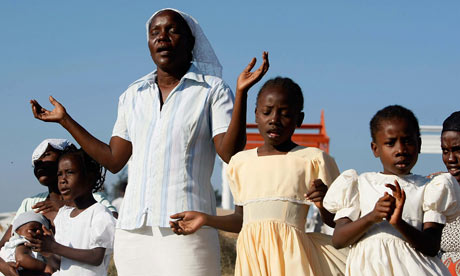
Pat Robertson may have received a lot of negative attention for his statement that God is punishing Haiti, but there are ways in which churches, and not just Robertson's, gain ground in the wake of disaster. We were silly to react to Robertson as we did: his message is as common as our world history of power and domination. Geographic exploration, colonialism, and war have all traditionally been ways to convert "the heathens/savages/locals" to more "civilized" ways of living and seeing the world.
That misfortune, disease, poverty, injustice, inequality are all punishment for sin is truly as old as ideas of redemptive suffering. The more you hurt, the closer you are to God. Why end suffering when it will bring you converts, souls? And for the believer, why cry out against the suffering that injustice causes when you're told that you deserve it?
Michelle Gonzalez Maldonado reminds us, at ReligionDispatches, that churches gain ground after disasters like the one in Haiti. She writes, citing Virginia Garrard-Burnett's work:
She correlates the explosion of Pentecostalism in Guatemala, who like Haiti, is an epicenter of Pentecostalism in the Americas, in part as a response to the earthquake. An overwhelmingly high percentage of Guatemalans saw the earthquake as a form of divine punishment and a call for repentance. Arriving in the guise of aid and relief, Protestantism provided an alternative way of being Christian. Yet Pentecostalism primarily emerged in Guatemala, as it did in Haiti, disconnected from North American denominations. Indigenous Pentecostalism, with its apocalyptic theology, also gained momentum among Indigenous Guatemalans.
Haiti had barely recovered from the four devastating storms of 2008 prior to this earthquake. The Roman Catholic Cathedral in Port-au-Prince has collapsed, and Archbishop of Port-au-Prince, Monsignor Joseph Serge Miot’s lifeless body was pulled from the ruins of the diocesan offices. U.S. Secretary of State Hillary Clinton has described the natural disasters that this nation has endured as “biblical” in nature. "It is biblical, the tragedy that continues to stalk Haiti and the Haitian people." Clinton does not realize that her comments would strike a chord with many Haitians today. Haitian Pentecostals, with their biblical literalism and their certainty that the second coming of Jesus is imminent, could see this time of tribulation as a challenge where the faithful will be rewarded on judgment day. Religion will surely play a role in the manner in which Haitians make sense of this tragedy, and I suspect we will find growing numbers of Pentecostal converts as Haitians attempt to find meaning in what can only be described as senseless and inexplicable suffering.
After crisis, struggling to make sense of death and destruction is easier when you can ascribe reasons to an outside power. Instead of preaching theologically sound ideas of community, mutual aid, justice and compassion, the Pentecostal church has found a way to prey on the fears of those in crisis. Tell them they are being punished for their sins, that their suffering is given by God, and that hurting in shamed silence will save their soul.
Fighting the foreign and national causes of Haiti's corrupt government, sub-standard buildings, poverty, and inability to care for its citizens, loses urgency when suffering makes you closer to God. If evil comes from God, how can you fight it? If salvation comes from suffering, why demand justice? Of course the government would prefer this type of theology to others - it's more passive, safer. And it reminds me of how abusers treat their victims: you deserve this punishment; now be good and take it so I can love you again.
The Guardian today corroborates Gonzalez Maldonado's conjecture with reports on how the Pentecostal church is working to expand in Haiti in the midst of crisis:
With the government's presence all but invisible, and humanitarian agencies and the UN struggling to cope with the demand for aid, groups of preachers are moving in to fill the void.
"I've started a school and we are trying to give people food and clothes," said Reverend Sauverne Apollon, 75, whose church – the Eglise Mission foi Caribéenne Independence d'Haiti – was one of the first to be constructed in the slum after its headquarters was destroyed in the quake.
"The people need hospital help, food and homes. I'm trying to do what I can," Apollon added.
As he spoke, UN troops used pepper spray and rubber bullets to contain Pont-Rouge's residents who were crushing together in their thousands in a queue for water and food. Peruvian soldiers from the UN stablisation force waved their shotguns about in an attempt to repel children who were trying to push into the seemingly endless queue.
Haiti has two official religions: Catholicism and voodoo, and the majority believe in some form of voodoo. But as in the rest of Latin America and the Caribbean, the number of born again Christians has risen sharply over the last 10 years. For Port-au-Prince's Pentecostal leaders the earthquake is an opportunity further spread their word among the city's homeless people.
"When God speaks we must listen," said Apollon, known in Pont-Rouge as "le pasteur". "The earthquake is God's voice and He will do other things. The stars will crash down onto the earth."
Later the article states:
"Whether you are a [Pentecostal] preacher, a Catholic priest or voodoo, it's the same. Humanity needs to say: 'Stop. Stop now. Stop the sinning'."I think it's time for a little liberation theology - too an indigenous Latin American product - to revive to counter all that redemptive suffering.
Labels: haiti, injustice, liberation theology, redemptive suffering

A couple of weeks ago, in "Uganda 'kill the gays' story underscores--bearing false witness lies at 'Religious Right's' core", I quoted the following from Rick Warren's belated public rejection of the Ugandan bill that would put gays to death:5. What did you do when you heard about the proposed Ugandan law?snipI wrote to the most influential leader I knew in that country, the Anglican Archbishop of Uganda, and shared my opposition and concern. He wrote me back, saying that he, too, was opposed to the death penalty for homosexuals. There are thousands of evil laws enacted around the world that kill people (For instance, last year, 146,000 Christians around the world were killed because of their faith.). In this case, I knew the Archbishop in Uganda, so I did what I could, but my influence in that nation has been greatly exaggerated by the media.
These figures are patently bogus--as I will shortly demonstrate. But they are also, apparently widely believed in the evangelic community. It helps to notice first of all that there is simply no comparison to executing people for being gay. Murdering people because of their religious beliefs is utterly heinous, but it is not state action, and not the least bit comparable to the sort of law beingcontemplated by Warren's purpose-driven fans. (Depsite his attempts at distancing, Uganda is only the second African state to declare itself a "purpose-driven" nation. Their purpose, apparently, is state-sanctioned murder. Aimlessness and slackitude never looked so good.)The total number of state murders worldwide in 2008 was around 2400, according the NY Times article on Amnesty International's report in March of this year:
Amnesty International said at least 2,390 people were executed worldwide in 2008, compared with its 2007 figure of at least 1,252.With at least 1,718, China was responsible for 72 percent of all executions in 2008, the report stated. After China were Iran (346), Saudi Arabia (102), the United States (37) and Pakistan (36), according to the group.
"Together they carried out 93 percent of all executions worldwide," the report said.
Nice company we keep, no? And it's even possible that some of those state murders have a religious component to them. But martyrdom is something a bit more specific--it's death that results from refusing to renounce one's beliefs. While it's equally heinous that one should be put to death, say, for publicly observing a forbidden religious practice, that's notquite the same thing--unless, of course, one is told that the death penalty would be dropped, if only one would renounce one's faith. Because of such subtleties, it's certainly possible that cases of true martyrdom can be found in these numbers. But there is nothing here comparable to the mass executions of martyrs in olden days.
snip
There's something even worse than a lack of evidence of widespread martyrdom: evidence of false marytrdom. Such apparently may have been the case with one of the victims at Columbine, as recounted in a 2008 article in Christian Century, by Jason Byassee, "How martyrs are made: stories of the faithful". The article begins:
ONE OF THE TEENAGERS killed in Colorado's Columbine High School shootings in 1999 was Cassie Bernall. Soon after her murder, reports emerged about how one of the shooters had found Bernall under a table, pointed a gun at her head and asked, "Do you believe in God?" She said yes and was promptly shot.Within weeks of that event I heard a sermon at an Episcopal church praising Bernall's witness and urging Christians to imitate her faithfulness. Prognosticators predicted another Great Awakening in American life sparked by Bernall's martyrdom. Billboards appeared that announced, "She Said Yes." Her mother penned a memoir using the phrase as its title, and a Web site started selling "She Said Yes" T-shirts and other merchandise.
There was one problem: the reported exchange between Bernall and her killer may never have happened. Students who were within earshot of the event disputed the account. One survivor claimed that she, not Bernall, had been the one questioned by the shooter. Those who made grand claims for Bernall started backpedaling. Some suggested that the story was important whatever the facts behind it. Elizabeth Castelli, who recounts this history in Martyrdom and Memory, points out that this latter rationalization was an odd one to come from Christians who also adhere to biblical literalism; they would never say the truth behind a biblical story is what counts, whether or not the event happened. Stories like Bernall's suggest some of the reasons to hesitate when confronted with claims to martyrdom.
It's not Byassee's intent to deny Bernall's martyrdom, or to dismiss martyrdom in general, but to unsettle people from their preconceptions. Indeed, his article is a very serious consideration of martyrdom, drawing largely on the non-violent Anabaptist tradition (particularly Mennonites.) But it is permeated with questioning, and challenges to certainty. For example:
In To Share in the Body: A Theology of Martyrdom for Today's Church (Brazos), Craig Hovey, a Mennonite theologian trained at Fuller and Cambridge, argues that Christianity is a training for martyrdom. Martyrdom is not a tragic mistake, nor is it a historical relic from a bygone age. It is "a gift of God to the church." Christians cannot and should not hope for martyrdom, but they must be prepared for it.Hovey argues against any utilitarian reading of the martyrs. Martyrdom makes no argument. Martyrs should not be used to argue that someone else's religion is bad or that some other country deserves retribution. In the New Testament "martyrs do not die because they fight for what is right, but precisely because they refuse to fight for what is true."
Of course, the evangelical practice of using martyrs is what got me writing this diary in the first place. And it's the deeper meaning of the phrase "False Martyrs" that heads this section. The Anabaptists cited in this article point in a very different direction:
Chris Huebner, another Mennonite theologian (he teaches at Canadian Mennonite University), argues in A Precarious Peace (Herald) that the ambiguity that surrounds claims to martyrdom is all to the good. The truth about martyrs is always something a community must pursue, without claiming to capture or possess it. In fact, arguing about martyrdom is part of the church's growth in holiness. Martyrdom is a "work of memory"--no one can declare herself a martyr, only the community can. "The very designation of martyrdom is a fragile and tenuous one, existing ... between the twin extremes of suicide and victimhood." Huebner grants to Elizabeth Castelli the point that remembrances of martyrs are always constructs, never able securely to capture truth.The attitude here is strikingly different from the smug self-certainty of the evangelicals, which Byassee does not comment on directly.
The assignation of martyrdom as a gift from God allows that it not be reliant on facts from Amnesty International or any other study/advocacy organization - or indeed on facts at all - to serve as a "gift" to the church and believers.
But even among non-believers, as I look more closely at ideas of redemptive suffering and doctrinal medicine (predominantly practiced by the 624 Catholic hospitals in the US), I find that statistics regarding pain and suffering at the end of life are often much less powerful an opponent in the fight for elder rights than the myth of martyrdom or suffering as a necessary and redemptive aspect of life.
Disclosure: The fabulous Elizabeth Castelli, mentioned in the lengthy quote above, is a friend. You can find her books here, including Martyrdom and Memory: Early Christian Culture Making, cited above.
The image above is from Martyrs' Mirror, the 1660 book of martyrs that chronicles the deaths of Christian believers, the second most common book found in Anabaptist churches.
Labels: elder rights, martyrdom, palliative care, redemptive suffering, rick warren, uganda